Most homeowners never think about demolition until they see it on the bid. Then there’s a line for $1,500 and the reaction is always the same: it’s a small room, how can taking it apart cost that much?
Bathroom demolition cost in Bellevue runs about $700 to $3,500 for most jobs (estimate), and the spread is wide for a reason. You’re not paying someone to swing a hammer. You’re paying for tile set in mortar 40 years ago, a cast iron tub that has to come down a staircase, the asbestos survey the county wants before anyone opens a wall, and dump fees on debris that can weigh more than a ton. Here’s what the numbers actually look like.
What bathroom demolition costs in Bellevue
| Scope | Typical cost (estimate) |
|---|---|
| Powder room / half bath, surface strip | $400 – $900 |
| Standard hall bath (5×8), standard finishes | $700 – $1,800 |
| Full gut to the studs, primary bath | $1,500 – $3,500 |
| Large primary suite, stone tile, multiple fixtures | $3,000 – $5,000+ |
| Per square foot, most jobs | $5 – $12 /sq ft |
These are 2026 estimates for Bellevue and the greater Eastside, and they assume no asbestos and no rot — both separate line items, both below. Our general bathroom remodel cost guide puts demolition at $700 to $2,500 on a typical job, which is the middle of this table and the number most homeowners should plan around.
What you’re actually paying for
| Line item | Cost (estimate) |
|---|---|
| Fixture removal — toilet, vanity, sink | $150 – $450 |
| Bathtub removal (cast iron at the high end) | $150 – $600 |
| Tile removal, thin-set over backer | $2 – $7 /sq ft |
| Tile removal, old mortar bed | $4 – $8 /sq ft |
| Grinding off leftover thin-set or mastic | +$1 – $3 /sq ft |
| Drywall or cement board removal | $1 – $3 /sq ft |
| Subfloor replacement | $3 – $10 /sq ft |
| Dust containment and floor protection | $150 – $400 |
| Debris disposal | $350 – $1,000 |
Labor runs about $60 to $75 per hour per crew member here, and a standard bath takes roughly 8 to 16 man-hours to strip — two people for a day and a half is normal.
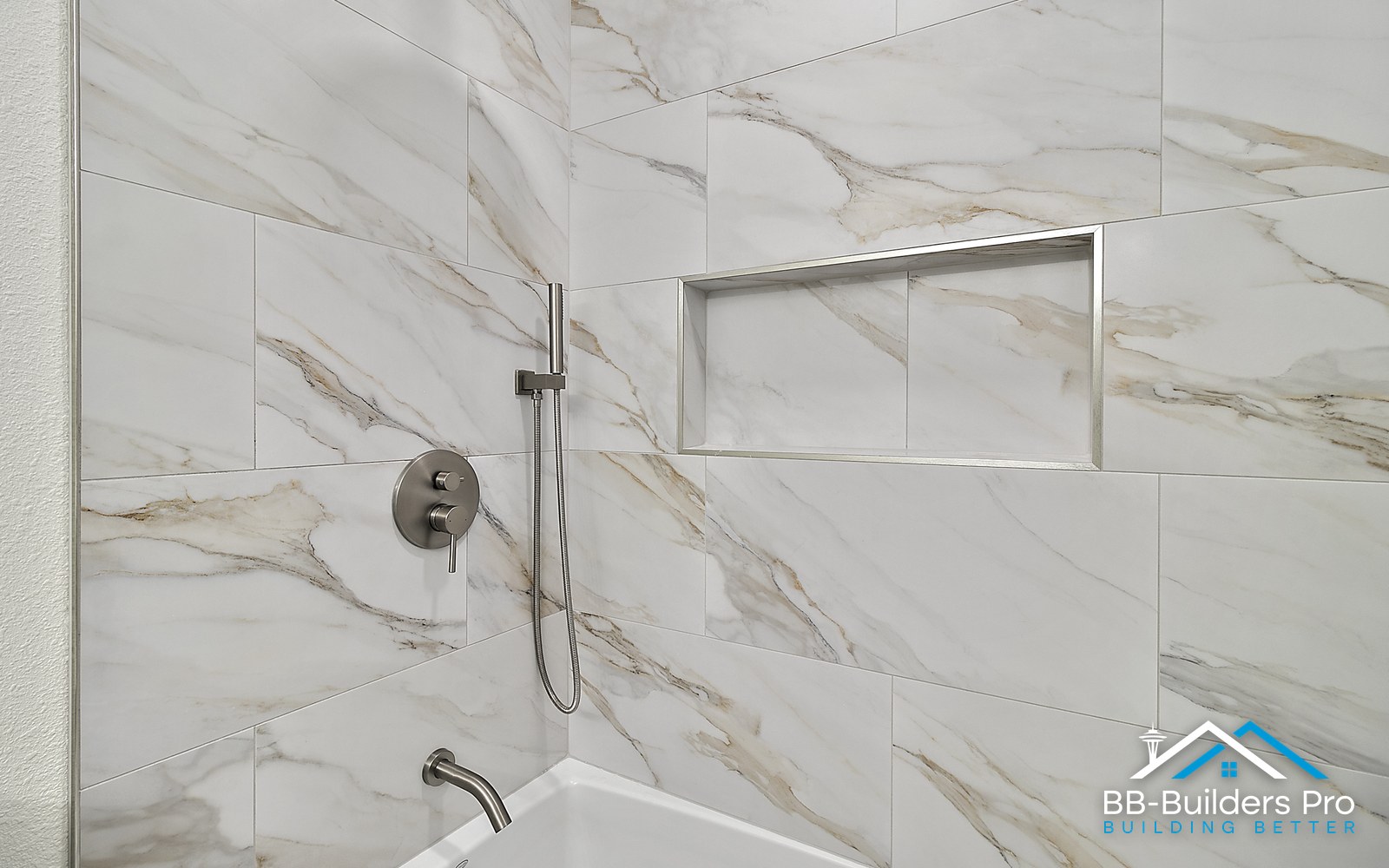
Tile removal moves the number more than anything else
Everything else on a demo bid is fairly predictable. Tile is not. Thin-set over cement board comes off reasonably — $2 to $7 per square foot (estimate). An old mortar bed is a different job, and in Bellevue’s 1950s and 60s stock through Lake Hills and Wilburton it often was: chipping out an inch of concrete with wire mesh in it, $4 to $8 per square foot, slow and loud.
The tell is thickness. Pop one tile off — a solid grey bed underneath means mortar bed, a thin skim over board means thin-set. Worth checking before the bid is final, because it’s the difference between a $600 tile line and a $1,400 one on the same little floor. And pulling tile off plywood usually leaves thin-set stuck to the wood that new flooring can’t go over; grinding it flat adds $1 to $3 per square foot.
The asbestos rule that catches Bellevue homeowners
This is the one nobody budgets for, and it’s stricter than most people assume.
The Puget Sound Clean Air Agency requires an asbestos survey of the work area before renovation or demolition begins. If you live in and own the single-family house being remodeled, you may do your own survey. Here’s the catch: that exemption reads remodeled, not demolished. A rental, a condo, or an actual demolition means hiring an AHERA-certified inspector. A survey for a bathroom-scale job runs $250 to $850 (estimate) including samples and lab work.
What happens next depends on the type of asbestos, and this is where most cost guides get it wrong:
- Nonfriable material — vinyl asbestos floor tile, the black mastic under it, caulking — needs no notification to the agency, and has its own removal method under the regulation. This is the most common find under a pre-1980 Eastside bathroom floor.
- Friable material — old pipe wrap, popcorn texture, some duct insulation — requires an Asbestos/Demolition Notification and filing fee before removal, and depending on project size a 10-day waiting period can apply. There’s an exemption below 10 linear feet of pipe or 48 square feet of surface area per structure per calendar year. A small hall bath floor is about 35 to 40 square feet, so a floor-only job often falls under that line while floor-plus-walls does not.
- A homeowner removing friable asbestos from their own single-family house files a Single-Family Residence Notification with a $30 filing fee. The moment a contractor does that work instead, it has to be a state-certified abatement contractor.
Abatement, when it’s needed, runs $5 to $15 per square foot for floor tile and mastic together, or roughly $1,200 to $4,000 for a bathroom-scale job (estimates). Encapsulating is cheaper at $2 to $6 per square foot but makes future removal harder. Practical version: if the house is pre-1990, schedule the survey during design. A 10-day wait discovered on demo day costs far more than the survey ever would.
What’s under the tile
Demolition is when a bathroom tells you the truth. Once the tub and tile are out we can see the subfloor, and in a wet room that’s been quietly leaking for 20 years it’s often soft.
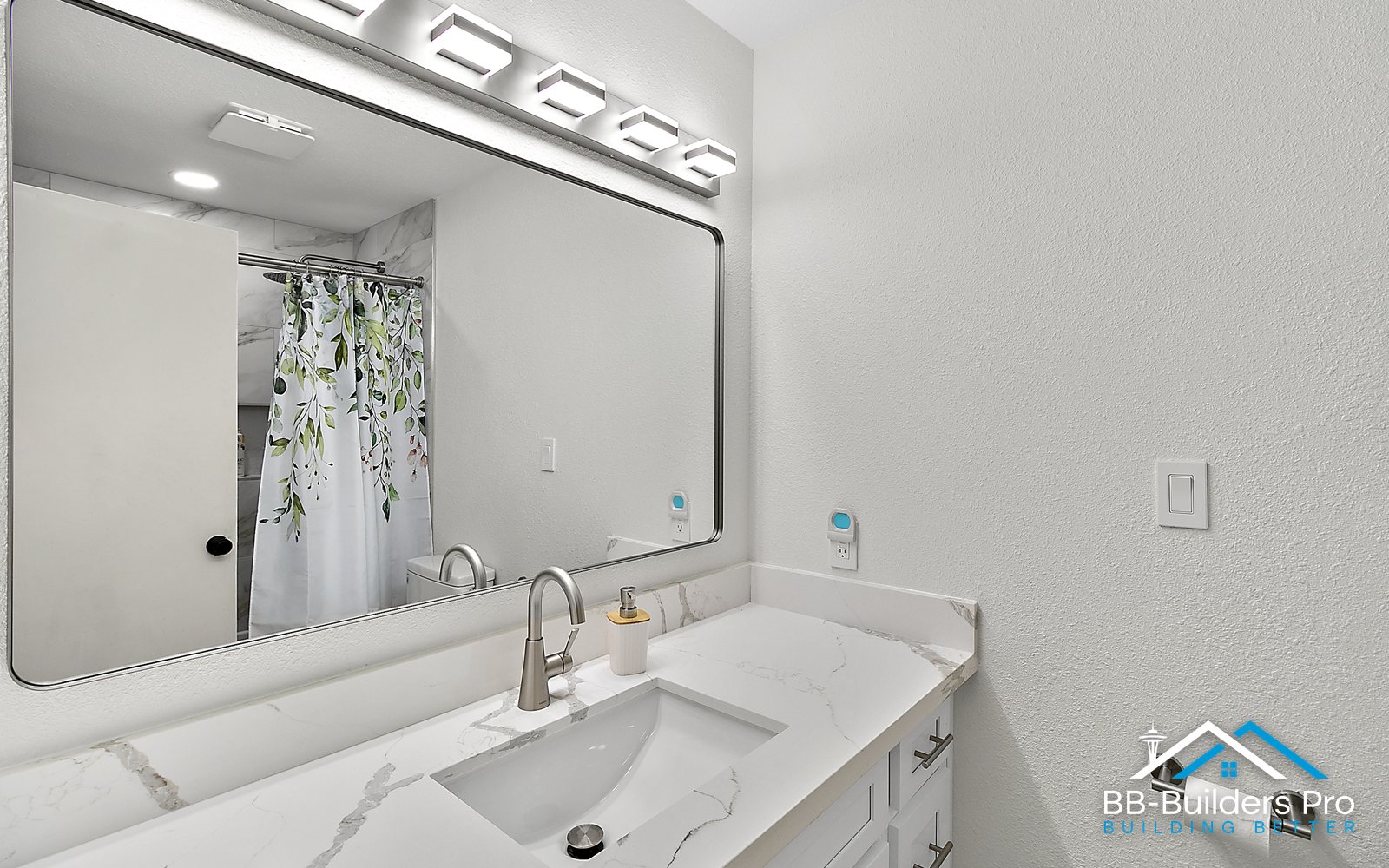
Replacing bathroom subfloor runs $3 to $10 per square foot (estimate), depending on whether it’s a patch around the toilet flange or full sheets, and on whether the joists are sound. If a joist is involved the scope changes — that’s structural. Our guides to shower pan replacement and bathroom subfloor repair go deeper.
Nobody can price this before demo, and no honest contractor will pretend otherwise. What we do instead is put an allowance in the contract with a written unit price, so if we find rot you already know the cost per square foot and there’s no negotiation mid-job. Ask for that — it’s one of the hidden costs of a bathroom remodel most worth planning for.
Where the debris goes
A gutted bathroom makes a heavy pile. Tile, mortar, cement board and a cast iron tub pass a ton easily, and disposal here is priced by weight. King County raised rates on January 1, 2026: self-haul is now a $40.25 minimum per vehicle and $243.38 per ton. That minimum sounds cheap until the scale reads 1.3 tons.
Usually a dumpster makes more sense. Seattle construction dumpsters run about $350 to $700; Bellevue sits higher at roughly $450 to $1,000 depending on size and debris weight (estimates), and going over the weight allowance adds $50 to $200 per extra ton. Ask explicitly whether disposal is in the bid — it’s a common gap between two quotes that otherwise look identical, and it’s on our quote comparison checklist for that reason.
Do you need a permit to demo a bathroom in Bellevue?
Bellevue has no standalone residential interior demolition permit — demolition appears in the city’s permit list under commercial and multifamily work. For a house, the permit follows what you put back.
The city’s fixture rule is short and specific. A permit is required to install a new fixture, or to move one in a way that needs water lines, drains or vents installed or modified. No permit for replacing a fixture with a similar fixture in the same location — wash basins, toilets, bidets, laundry tubs. Then the line that catches people: showers and bathtubs require permits.
So if the demo ends with the tub out and a new shower in, that’s permit work in Bellevue even if nothing moves an inch. Taking a wall out to enlarge the room pulls in an interior remodel permit, and if that wall carries load, read our guide to load-bearing wall removal first. For scheduling, Bellevue issues permits that need no plan review the same day; inspections still apply.
Should you demo it yourself?
Sometimes, and it can save a few hundred to over a thousand dollars. It works when the tile is thin-set over backer, the house is post-1990 so asbestos isn’t in play, you can haul heavy debris, and your contractor agrees to it in writing before the schedule is built.
It goes badly with a mortar bed, with an un-surveyed older house, or when a supply line breaks behind a wall. We’ve been called into that last one more than once, and the water damage cost more than the demo saved. Ask first, too: if your contractor is doing the rebuild, they usually want to control the demo, because they’re warrantying what goes back.
On timing, a powder room is a day, a standard hall bath one to two, a full primary gut two to four — a small slice of how long a bathroom remodel takes, but the phase that sets up everything after it.
Five ways to keep demolition costs down
- Get the asbestos survey done during design, not during demo.
- Keep fixtures where they are — moving a toilet or tub means opening the floor and, in Bellevue, a permit.
- Ask for a written unit price on subfloor repair instead of a vague allowance.
- Confirm who pays for disposal and what the weight allowance is.
- Bundle the demo. If a tub-to-shower conversion is on your list for later, doing it now means paying for one demo instead of two.
Frequently asked questions
How much does it cost to demo a bathroom in Bellevue?
Most bathroom demolition in Bellevue runs $700 to $3,500 (estimate), or about $5 to $12 per square foot. A standard 5×8 hall bath usually lands between $700 and $1,800. Old mortar-bed tile, a cast iron tub, or asbestos push it higher.
Why is tile removal so expensive?
Because of what’s under it. Tile set over cement board comes off for $2 to $7 per square foot. Tile set in an old mortar bed means removing an inch of reinforced concrete at $4 to $8 per square foot (estimates) — slow work in a small room.
Do I need an asbestos survey before a bathroom demo in Washington?
Yes. Puget Sound Clean Air Agency rules require a survey of the work area before renovation or demolition begins. If you live in and own the single-family house being remodeled you may do your own survey, but a rental, a condo, or a demolition requires an AHERA-certified inspector. Budget $250 to $850 (estimate).
Do I need a permit to demolish a bathroom in Bellevue?
Bellevue has no standalone residential interior demolition permit — the permit follows what you install. Replacing a toilet or basin with a similar one in the same location doesn’t need one, but showers and bathtubs do, as does moving any fixture that requires modifying water lines, drains or vents. Permits without plan review are issued same day.
Can I demo my own bathroom to save money?
Often yes, saving a few hundred to over a thousand dollars. It’s a poor idea if the house is pre-1990 and hasn’t been surveyed for asbestos, if the tile is in a mortar bed, or if your contractor’s schedule depends on demo finishing on a set date. Get it agreed in writing first.
What do I do with the debris?
Self-haul or rent a dumpster. King County self-haul is $40.25 minimum per vehicle plus $243.38 per ton as of January 1, 2026, and tile and mortar are heavy. A construction dumpster runs roughly $450 to $1,000 in Bellevue (estimate). Make sure the bid says which is included.
Thinking about gutting a bathroom in Bellevue?
We look at what’s actually behind your tile before we give you a number, and the demo line on our bids is itemized so you can see what you’re paying for. Give us a call at 206-851-4233 or get in touch here. If you’re still planning, our Bellevue bathroom remodeling page walks through how we run these projects start to finish.