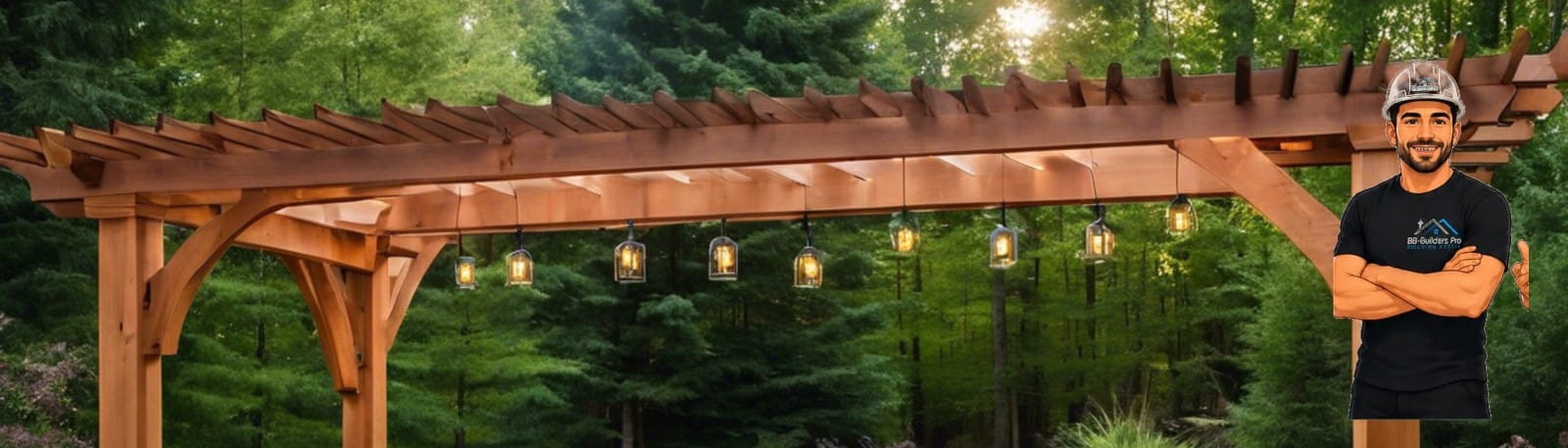
Pergola installation cost in Seattle runs about $10 to $65 per square foot installed, depending on whether you’re setting a prefab kit on an existing patio or having a cedar structure built from scratch. For the 12’x12′ size most homeowners ask about, that works out to roughly $1,450 to $5,750 for a kit installed and $4,300 to $9,350 for a custom build. If the pergola is going over a new deck, price the deck separately — our TimberTech deck cost guide has current numbers.
Those are national ranges. Labor here runs on the higher end, so most of our Seattle-area pergola projects land in the upper half.
We build a lot of outdoor living space around Puget Sound, and pergolas come up in almost every conversation. Here’s what actually drives the price, what the permit rules are in Seattle, and what holds up in our weather.
Pergola cost at a glance
| Pergola (12’x12′) | Typical installed cost |
|---|---|
| Prefab kit, contractor-installed | $1,450 – $5,750 |
| Custom-built wood (cedar) | $4,300 – $9,350 |
| Per square foot — kit installed | $10 – $40 |
| Per square foot — custom built | $30 – $65 |
| Louvered roof, manual crank | $45 – $110 / sq ft |
| Louvered roof, motorized | $55 – $125 / sq ft |
| Louvered roof, motorized + sensors | $75 – $175 / sq ft |
| Wood lattice roof | $25 – $50 / sq ft |
| Retractable fabric canopy | $4 – $10 / sq ft |

What changes the price
Size. This is the big one, and it isn’t linear — a bigger pergola needs bigger beams and deeper footings, not just more lumber. An 8’x8′ custom build runs about $1,900 to $4,150. A 16’x20′ runs $9,600 to $20,800.
Kit or custom. A kit is pre-cut and gets bolted together on site. Custom means we size the beams for your span, match the post detail to your house, and cut the rafter tails on site. Custom typically costs two to three times a kit.
Material. Material alone, before labor:
- Aluminum or vinyl — $10 to $30 per sq ft
- Pressure-treated pine — $20 to $40
- Cedar — $25 to $40
- Redwood — $40 to $50
- Fiberglass — $50 to $70
- Teak and other hardwoods — $55 to $100
Attached or freestanding. Attaching one side to the house takes out two posts and some material cost — but it adds a ledger board and flashing, which is where these projects go wrong if the crew rushes it. More on that below.
What the posts land on. If you already have a level concrete patio or a solid deck, we anchor to it and you’re done. If you don’t, budget for the base: a concrete slab runs $5 to $10 per square foot, a new deck $25 to $50 per square foot.
Extras. An outdoor outlet is $180 to $350. Outdoor light fixtures run $80 to $300 each. Staining or sealing a wood pergola is $2 to $5 per square foot, and here it’s not optional.
Labor. Assembling a kit is $600 to $1,500. A custom build is $2,000 to $7,000 in labor, or roughly $50 to $120 an hour.
Do you need a permit for a pergola in Seattle?
Usually not — if you keep it small and open.
Seattle SDCI does not require a permit for arbors or other open-framed landscape structures that don’t exceed 120 square feet. That is the exact line, and it catches people out:
- 10′ x 12′ = 120 sq ft. Right at the limit. No permit.
- 12′ x 12′ = 144 sq ft. Over the limit. Permit.
Two other things flip it into permit territory even under 120 square feet: putting a solid roof on it (now it’s a patio cover, not an open-framed structure), and attaching it to the house, which makes it part of the building. A pergola sitting on a deck more than 18 inches above grade brings the deck’s own rules into it too.
Outside city limits the numbers change. Unincorporated King County and Snohomish County both run their own exemption thresholds, so check with the county before you assume. Permit fees themselves are small — usually $60 to $150 — and we pull them as part of the job.
Building a pergola that survives Seattle weather
A pergola is an open structure. It gives you shade, not shelter. In a climate where it rains eight months a year, that’s the first honest conversation to have.
If the goal is “somewhere to sit in July,” an open cedar pergola is a good buy. If the goal is “use the patio in November,” you want a louvered aluminum roof that closes, or a solid cover — which is a different project. We wrote up that comparison in our covered patio cost guide for Seattle.
A few things we do differently here than a contractor in Arizona would:
Post bases get standoff brackets. Wood posts set flat on concrete wick up water and rot from the bottom. Galvanized standoff bases lift the post about an inch off the slab so it drains and dries. It’s a cheap detail that decides whether the structure lasts 8 years or 30.
Cedar gets sealed, and gets sealed again. Cedar is naturally rot-resistant, which is why it’s the default here — but our winters are wet and our summers are UV-heavy. Plan on re-sealing every two to three years. North-facing sides will grow moss; that’s normal and it washes off.
Flashing on the ledger, always. If the pergola attaches to the house, the ledger board has to be flashed and the fasteners have to hit framing, not just siding. A leaking ledger doesn’t show up as a drip — it shows up as rot inside the wall two years later. It’s the most common failure we get called out to fix.
Footings sized for our soil. A lot of Puget Sound lots are glacial till or fill. Post footings need to reach undisturbed soil and get below frost depth. Skipping this is why some pergolas start leaning after a couple of wet winters.
Pergola, patio cover, or deck? What we usually recommend
Most of the calls we get aren’t really about a pergola — they’re about wanting more usable outdoor space. The right answer depends on how you’ll use it:
- Shade over an existing patio, summer use → open pergola. Cheapest path, $4,000 to $9,000 for a good cedar build.
- Year-round use, want to be dry → louvered roof or a solid covered patio. Costs more, gets used more.
- No usable flat surface yet → the deck or slab comes first. See our deck cost guide, composite vs. wood.
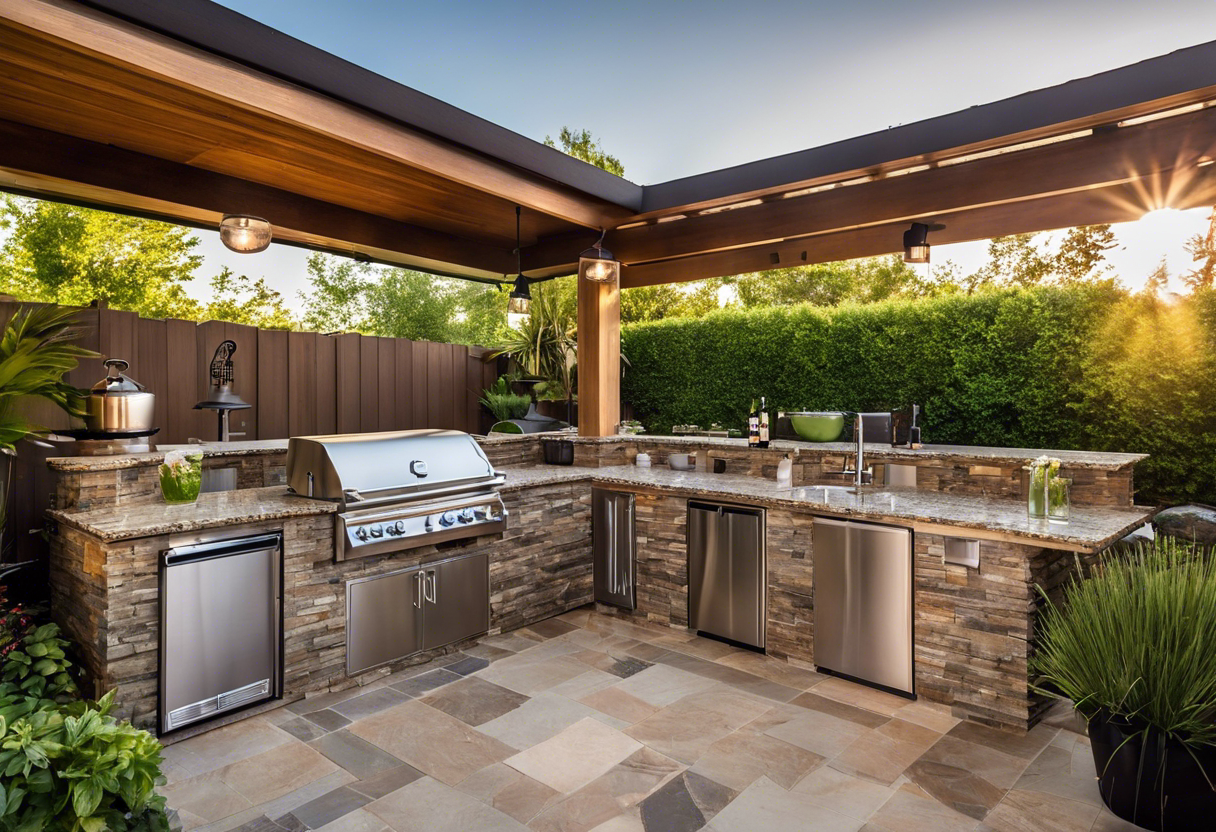
- Cooking and entertaining out there → plan the pergola and the outdoor kitchen together. Running gas, water and power once is much cheaper than twice.
If you’re not sure which one fits, that’s a 20-minute conversation, not a sales pitch. Have a look at what we do across outdoor living and then call us.
Get a real number for your yard
Online ranges only get you so far. The price comes down to your site — what the posts land on, how far material has to be carried, whether we’re attaching to the house, and what you want the roof to do.
Call 206-851-4233 or send us the details and we’ll come out, look at the space, and give you a fixed price in writing. We build in Seattle, Bellevue, Renton, Edmonds, Federal Way and across King and Snohomish County.
Pergola FAQs
Do I need a permit for a pergola in Seattle?
Not if it’s an open-framed structure of 120 square feet or less. Seattle SDCI exempts arbors and other open-framed landscape structures at or under that size. Go bigger, add a solid roof, or attach it to the house, and you’ll need a permit. Fees usually run $60 to $150, and we handle the paperwork.
How much does a 12×12 pergola cost in Seattle?
Roughly $1,450 to $5,750 for a prefab kit installed by a contractor, or $4,300 to $9,350 for a custom cedar build. Seattle labor rates put most projects in the upper half of those ranges. Note that 12’x12′ is 144 square feet, so it needs a permit inside Seattle city limits.
Cedar or aluminum in our climate?
Cedar looks better against most Northwest homes and costs $25 to $40 per square foot in material, but it needs sealing every two to three years. Aluminum is $10 to $30 per square foot, never needs refinishing, and is the only practical choice if you want an adjustable louvered roof. If you want to sit outside in the rain, aluminum louvers win.
Does a pergola keep the rain off?
An open pergola, no. The rafters give you filtered shade and a sense of enclosure, but water goes straight through. A louvered pergola with a closing roof does keep you dry — that’s why it costs $45 to $175 per square foot instead of $10 to $65.
How long does a pergola installation take?
A kit on an existing patio is usually one to two days. A custom cedar build with new footings runs about three to five working days, plus concrete cure time before we set posts. Add a week or two upfront if the project needs a permit.