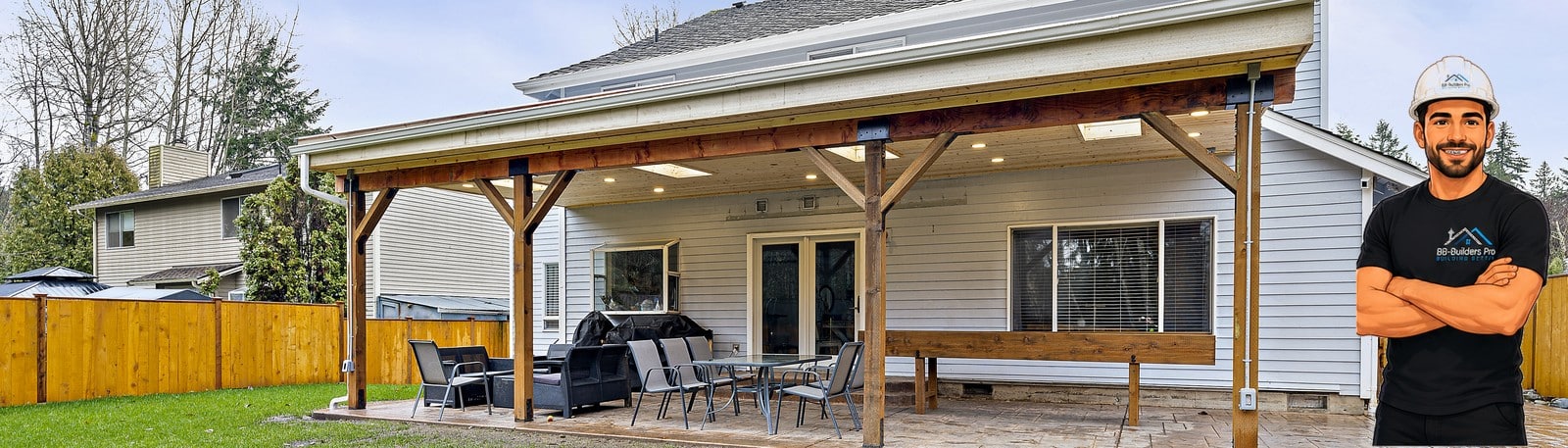
If you’re pricing a covered patio in Seattle, here’s the short answer: most homeowners pay somewhere between $20 and $60 per square foot to put a solid roof over an existing patio, and $50 to $150 per square foot if you’re building the whole thing — slab and cover — from scratch. That puts a typical 10×20 covered patio anywhere from $4,500 to over $22,000 depending on what you build. All figures in this guide are estimates based on 2026 national cost data and what we see on real projects around King County — your site and material choices will move the number. If the cover is going over decking rather than a slab, our TimberTech deck cost guide covers that material spend.
I build these all over Seattle, Bellevue, and Renton, and I’ll tell you the same thing I tell clients at the kitchen table: around here, the cover is not a luxury. It’s the difference between using your patio three months a year and using it ten.
Covered Patio Cost at a Glance (2026 Estimates)
| Project | Typical Cost (Installed) |
|---|---|
| Patio cover over existing slab | $20 – $60 per sq ft |
| Full covered patio (new slab + roof) | $50 – $150 per sq ft |
| Typical 10×20 patio cover project | $4,500 – $12,000 |
| Full 10×20 covered patio from scratch | $10,000 – $22,500 |
| Open-lattice wood cover (less rain protection) | $20 – $40 per sq ft |
| Solid wood cover | $60 – $120 per sq ft |
| Aluminum cover | $20 – $50 per sq ft |
| Freestanding pergola | $2,000 – $6,000 |
Sources: HomeGuide and Angi 2026 cost data. These are national averages — Seattle labor rates tend to land projects in the upper half of these ranges.
What Actually Drives the Price
Four things decide most of your budget:
Size. Pricing is mostly per square foot, so a 12×24 costs roughly double a 10×14 with the same materials. Bigger roofs also mean bigger beams and sometimes deeper footings.
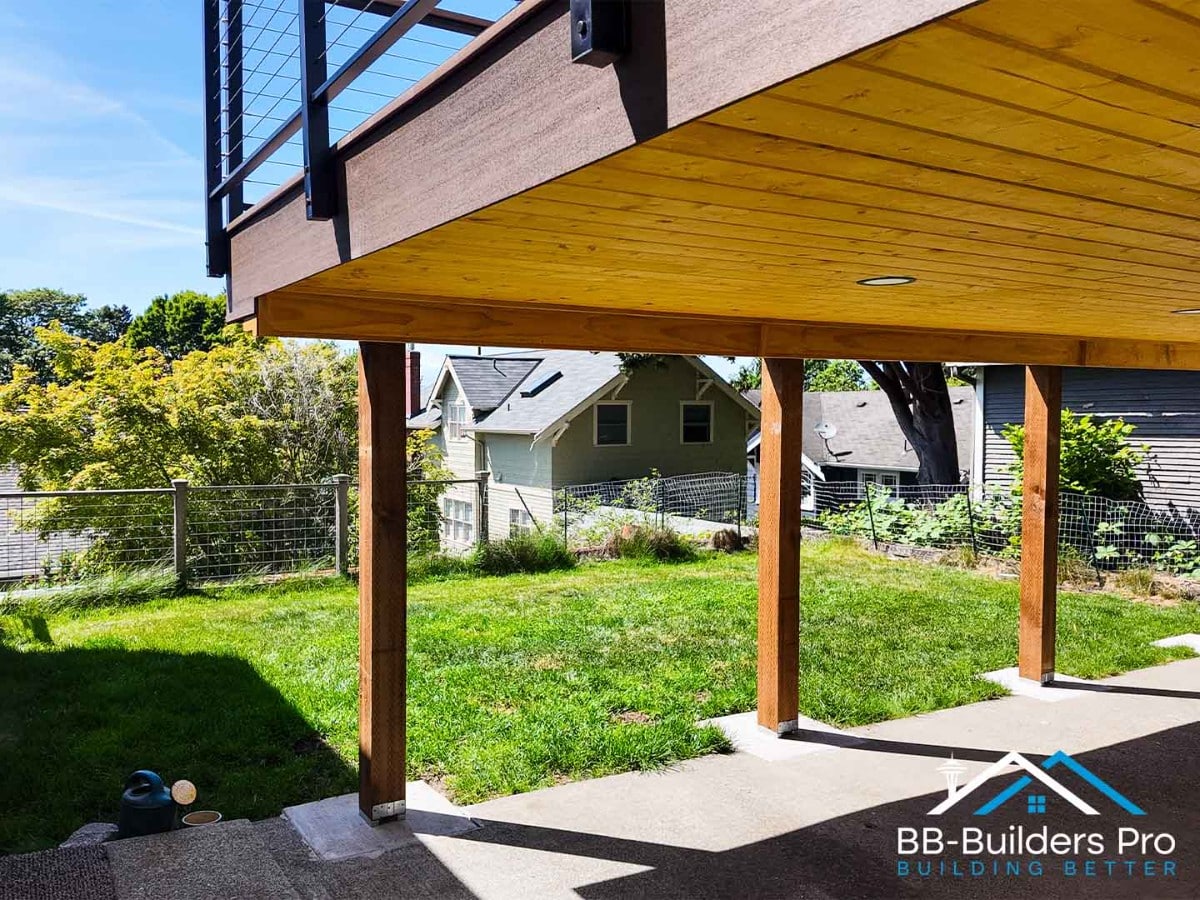
Attached or freestanding. An attached cover ties into your house with a ledger board — it usually looks better and costs less per square foot than building four posts and a full freestanding frame. But attaching to the house means flashing it right and, per Seattle code, tying it to the structure properly. Done wrong, an attached cover is how you get rot in your rim joist. That’s a repair we see too often.
Roof type. An open lattice is the cheapest — and nearly pointless in Seattle, because it doesn’t stop rain. A solid roof (framed and shingled to match the house, or a metal or polycarbonate panel system) costs more but works year-round. Matching the house roofline is the high-end look and the high-end price.
Site conditions. Sloped yard, poor drainage, or an old cracked slab that has to come out first — each adds real money. So does running electrical for lights, fans, or heaters, which is what makes a covered patio usable in January.
Patio Cover Cost by Material (2026 Estimates)
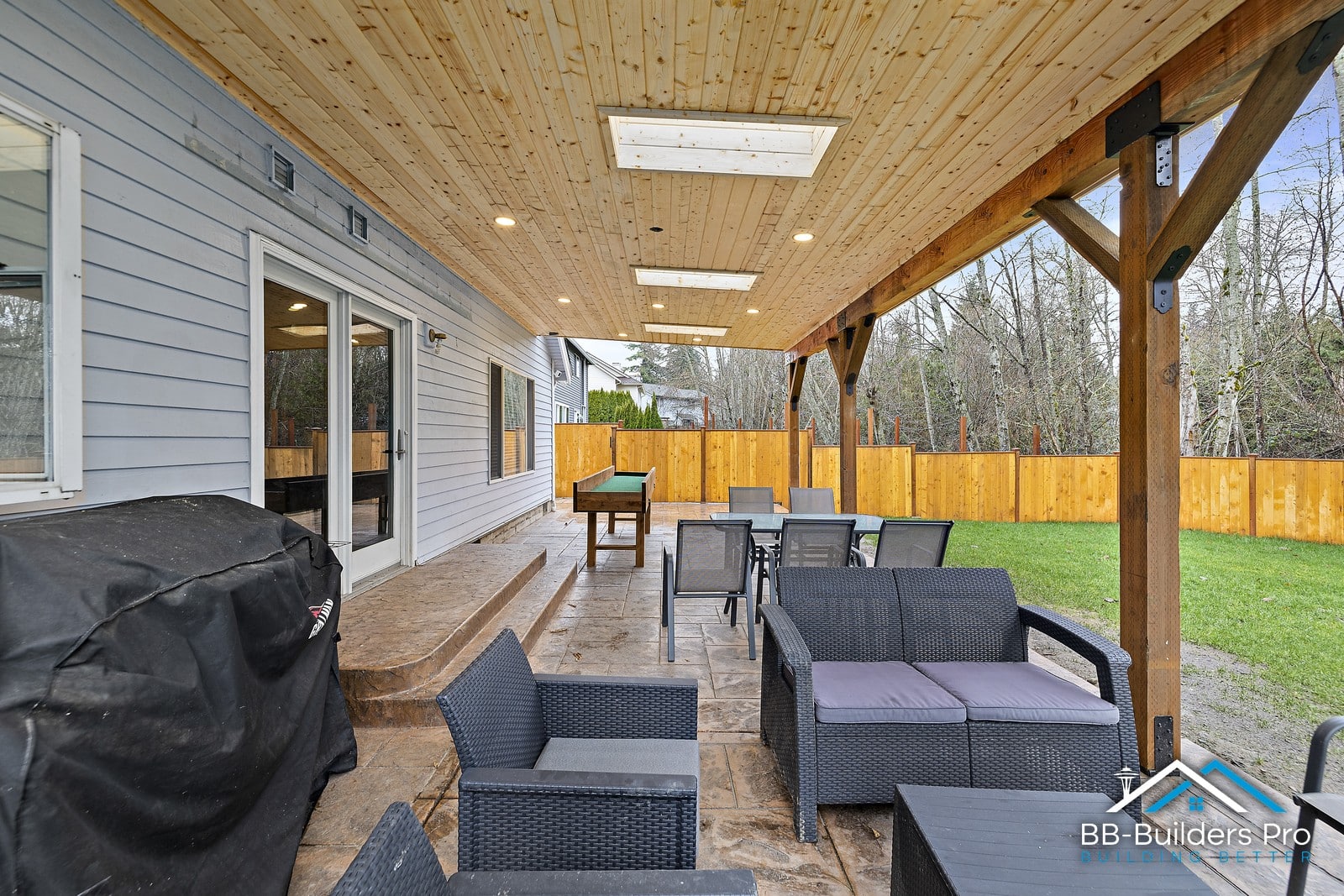
Wood framing is what we build most in Seattle — a solid cedar or fir structure, stained or painted, roofed to match the house. Expect roughly $60–$120 per square foot for a solid wood cover. It’s the best-looking option next to a craftsman or traditional home, and it handles our wet climate fine if it’s flashed, guttered, and finished right.
Aluminum covers run about $20–$50 per square foot installed. They’re the budget-friendly workhorse: no rot, low maintenance, decent snow and rain handling. The trade-off is looks — they read as an add-on, not part of the house.
Vinyl lands in between at roughly $25–$80 per square foot. Low maintenance, but color options are limited and big spans need more structure.
Louvered and motorized systems are the premium tier — adjustable slats that open to the sun and close against rain. Pricing varies a lot by brand and size; if you’re considering one, get a real quote rather than trusting an online average.
Covered Patio, Deck, or Sunroom?
These three get mixed up all the time, and the budgets are very different. A covered patio is a roof over an outdoor slab — open air, no walls. If your yard slopes or you want the outdoor space raised to door height, you’re really shopping for a deck, which prices differently. And if you want glass walls and a space you can heat, that’s a sunroom addition — a bigger project with a bigger budget.
A fair rule of thumb from our project history: covered patio, then deck with a roof, then sunroom, in rising order of cost. Start with how you’ll actually use the space in November, not July.
Do You Need a Permit in Seattle?
Usually, yes. In Seattle, a patio cover with a solid roof needs a building permit — the common exemption for small open-framed structures (under 120 square feet, no solid roof) doesn’t apply once you’re building real rain protection, which is the whole point here. Attached covers also have code requirements for how the ledger connects to the house, including hardware that handles seismic loads. Seattle’s Residential Code has a whole appendix just for patio covers.
Permit fees in Seattle are based on project valuation, so a straightforward cover typically adds several hundred dollars in city fees, plus plan-review time. Bellevue, Renton, and unincorporated King County each run their own permit process with similar logic. It’s not a reason to skip the permit — an unpermitted attached structure is a headache when you sell, and a liability if it ever fails. We handle permits on every covered patio we build, so this lands on our desk, not yours.
Building for Seattle Weather
This is the part national cost guides skip, and it’s where a local builder earns their fee:
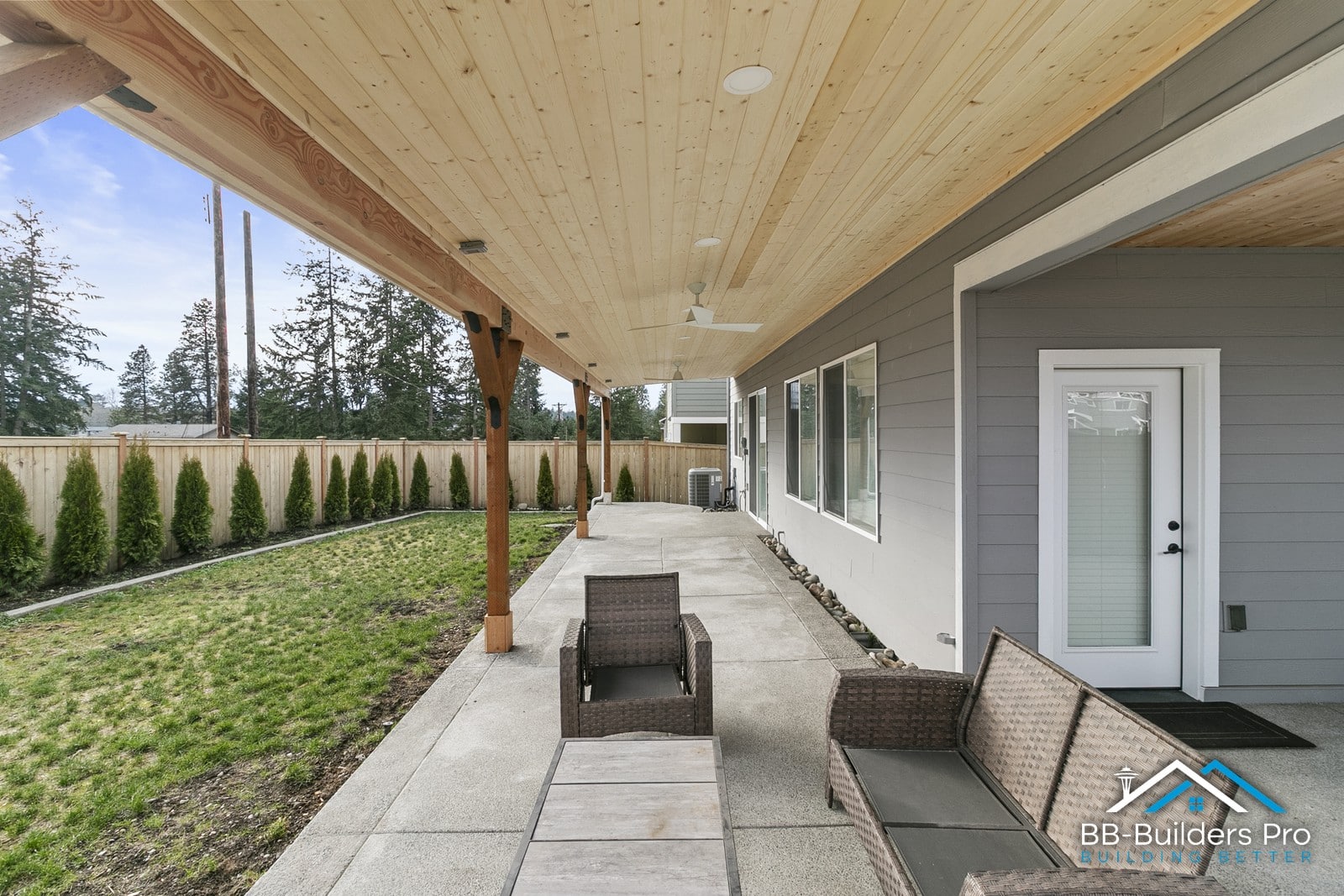
- Rain is the design driver. The roof needs real slope, gutters, and downspouts that tie into your drainage — not just dump 200 square feet of runoff next to your foundation.
- Flashing is everything on attached covers. Water that gets behind a ledger board rots the house quietly for years. Proper flashing and standoffs are non-negotiable in our climate.
- Footings matter in our soil. Wet winters mean posts need proper concrete footings below grade — not deck blocks sitting on soil that moves.
- Plan for moss. Polycarbonate and low-slope roofs grow moss here. Factor in cleaning access, or choose materials that shed debris.
- Add light and heat. Our covered patios get used year-round when there’s a ceiling fan rated for exteriors, decent lighting, and an infrared heater. Rough-in the electrical during the build — it’s cheap then, expensive later.
Is a Covered Patio Worth It in Seattle?
For most of our clients, yes — and it’s one of the most-requested projects we build. You’re turning a slab you use a few dry months a year into an outdoor room that works most of the year. Compared to a sunroom or addition, the cost of entry is much lower, and there’s no better market for a roof over your outdoor space than one where it rains from October to May.
If you’re comparing options for your yard, our patio cover installation page covers how we build them, and our outdoor living services page shows the bigger picture — patios, decks, and full outdoor kitchens.
Covered Patio Cost FAQ
How much does a covered patio cost in Seattle?
As a 2026 estimate, expect about $20–$60 per square foot to roof an existing patio, or $50–$150 per square foot for a new slab plus cover. A typical 10×20 project lands roughly between $4,500 and $22,500 depending on scope and materials. Get a site-specific quote — slope, drainage, and roof style move the number a lot.
Do I need a permit for a patio cover in Seattle?
If it has a solid roof, plan on a permit. Seattle exempts only small open-framed structures (under 120 square feet without a solid roof). Attached covers also have specific code requirements for connecting to the house. Your contractor should handle the permit — if they suggest skipping it, that tells you something.
What’s the cheapest way to cover a patio?
An aluminum cover, at roughly $20–$50 per square foot installed, is the most affordable solid-roof option. Open lattice is cheaper still, but it won’t keep the rain off — which in Seattle defeats the purpose.
Can you attach a patio cover to the house?
Yes, and most of ours are attached — it looks cleaner and uses the house for support. The critical details are flashing (keeping water out of the wall) and proper structural connection per Seattle code. This is the one part of the job I’d never DIY.
How long does it take to build a covered patio?
The build itself usually takes about one to two weeks once materials are on site. Permitting adds lead time ahead of that — often several weeks depending on the city’s review queue. Starting the process in late winter is the smart play if you want it done by summer.
Ready to price your covered patio? We design and build covered patios, decks, and outdoor living spaces across Seattle, Bellevue, Renton, and the Eastside. Call us at 206-851-4233 or request a free estimate, and we’ll walk your site, talk drainage and roofline, and give you a real number — not a national average.